AI automation · Private AI

Private AI on your own infrastructure

Generative AI over your contracts, case files and internal documents, running on your infrastructure or in a European private cloud. Your documents are never sent to public AI providers.

Request an AI assessment Calculate price

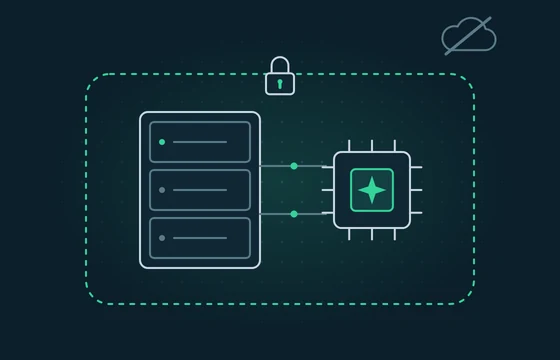
Illustration of a server and an AI chip inside the company’s protected perimeter
When it makes sense

When this way of working fits

  • Confidential or personal data that cannot leave the company.
  • Regulated sectors with obligations about where information is hosted.
  • Intellectual property and R&D you do not want to expose to a third-party service.
  • Companies that cannot use public AI because of internal policy or client contracts.
How it works

The journey of a query

One question, four steps and no public AI provider in the middle.

  1. UsersThey sign in with their Microsoft account and only see what they could already see.
  2. InterfaceOur own application with corporate sign-in: no new accounts and no shared passwords.
  3. Model on your serverThe open model runs on your infrastructure or in a private cloud in the European Union.
  4. Your documentsQueried with each user's permissions and never sent to public AI providers.
A person signs in to the interface with their Microsoft account, the query travels to the model and the answer is built only from the documents that user is allowed to open. Neither the question nor the documents go through a public AI provider.
Data and location

Where each part runs

  • On your infrastructure: the model, the queries and the documents stay on your servers. No AI provider is involved.
  • In a European private cloud: the model runs at a European provider under contract and the data is hosted in the European Union. It does not go through public AI providers either.
  • Identity: corporate sign-in is provided by Microsoft. Authentication does not pass through our systems.
  • Support, logs and backups: support, logging and backup providers are involved, with restricted access and logged activity.
What it includes

Four phases, from trial to operation

1. Use case and data

We pick the process and the documents worth starting with, and review which permissions must be respected.

2. Pilot

We test it with two or three real processes and real users, and measure quality before widening it out.

3. Production

Named users, query logging, backups and monitoring from our SOC.

4. Ongoing operation

Model updates, quality reviews and cost control as usage grows.

Security

What is not negotiable

  • Each user only queries the documents they can already open: permissions are neither duplicated nor relaxed.
  • Data connectors are read-only, so the AI never changes your systems.
  • Every query is logged so you can audit what was asked and what answer was given.
  • Controls against hidden instructions in documents: content filtering, read-only permissions and human review of actions, to reduce the risk of a file changing the model's behaviour.
Indicative price

What does Private AI on your own infrastructure cost?

Calculate several services

Common questions

Questions about Private AI on your own infrastructure

Is it as good as ChatGPT or Copilot?
For working on your own documents it is usually enough. In complex reasoning, the best cloud models are still ahead. We measure it in the pilot before deciding.
Do I need to buy servers?
It depends on the case: a GPU server on your premises or a private cloud in the European Union. We size it in the assessment.
Who sees my data?
Only your authorised users. We access it solely to operate the service and every access is logged.
Which models do you use?
Open models such as Qwen, Gemma, Mistral or gpt-oss, chosen by licence, language and use case. They are examples of available technology: we are not a partner of, or accredited by, any of them.
How does it fit with the EU AI Act?
The systems you run also fall within the scope of the Act: transparency duties, data control and, where applicable, high-risk requirements, which will be required from December 2027. See AI governance
News

Related news

See all the news

You may also be interested in

Related services

Which documents would you never upload to a public AI?

We start with that case: we test it in a pilot with your data, without it leaving your environment.

Request an AI assessment